
Petra Butler · 29 September 2026
Navigating Technical SEO Hurdles in Enterprise Platform Transitions
Enterprise organizations frequently face complex technical SEO challenges when shifting from legacy systems to modern platforms, and these transitions often involve changes to URL structures, server configurations, and content delivery mechanisms that directly affect crawlability and indexing. Data from industry reports shows that improper handling of redirects during such migrations can lead to significant drops in organic visibility, while coordinated efforts in preserving link equity and site architecture help maintain rankings over time. Researchers at various academic institutions have documented how JavaScript-heavy frameworks introduced in new platforms require additional rendering considerations to ensure search engines can access full content without delays.
Core Technical Challenges in Platform Shifts
Platform transitions in large-scale environments typically introduce hurdles around crawl budget allocation because new systems may generate dynamic URLs or infinite scroll elements that consume resources inefficiently, and studies indicate enterprises must audit these elements before launch to prevent indexing bottlenecks. Structured data implementation often breaks during migrations when schema markup fails to transfer correctly across content management systems, leading to lost rich snippet opportunities in search results. Those who have analyzed post-migration data note that mobile-first indexing demands consistent responsiveness across all templates, whereas legacy desktop-focused designs create compatibility gaps that algorithms penalize through reduced rankings.
Site speed metrics represent another critical area since new platforms introduce additional scripts or third-party integrations that inflate load times, and performance monitoring tools reveal patterns where unoptimized images and fonts compound these issues. In September 2026, several updates to core web vitals reporting standards took effect, requiring teams to recalibrate their optimization priorities around interaction to next paint values alongside existing largest contentful paint measurements. Observers note that API-driven content delivery common in enterprise setups can create duplicate content risks if canonical tags are not configured precisely during the switchover process.
Redirect Strategies and URL Mapping
Comprehensive URL mapping forms the foundation of successful transitions because mismatched redirects fragment authority signals across old and new addresses, and evidence from migration case studies demonstrates that 301 redirects applied at scale preserve more equity than temporary 302 codes. Enterprises often employ automated scripts to generate these maps from server logs, yet manual verification remains essential for high-value pages that drive substantial traffic. Crawl budget optimization becomes intertwined with redirect chains since excessive hops slow down bot traversal and delay reindexing of updated content.
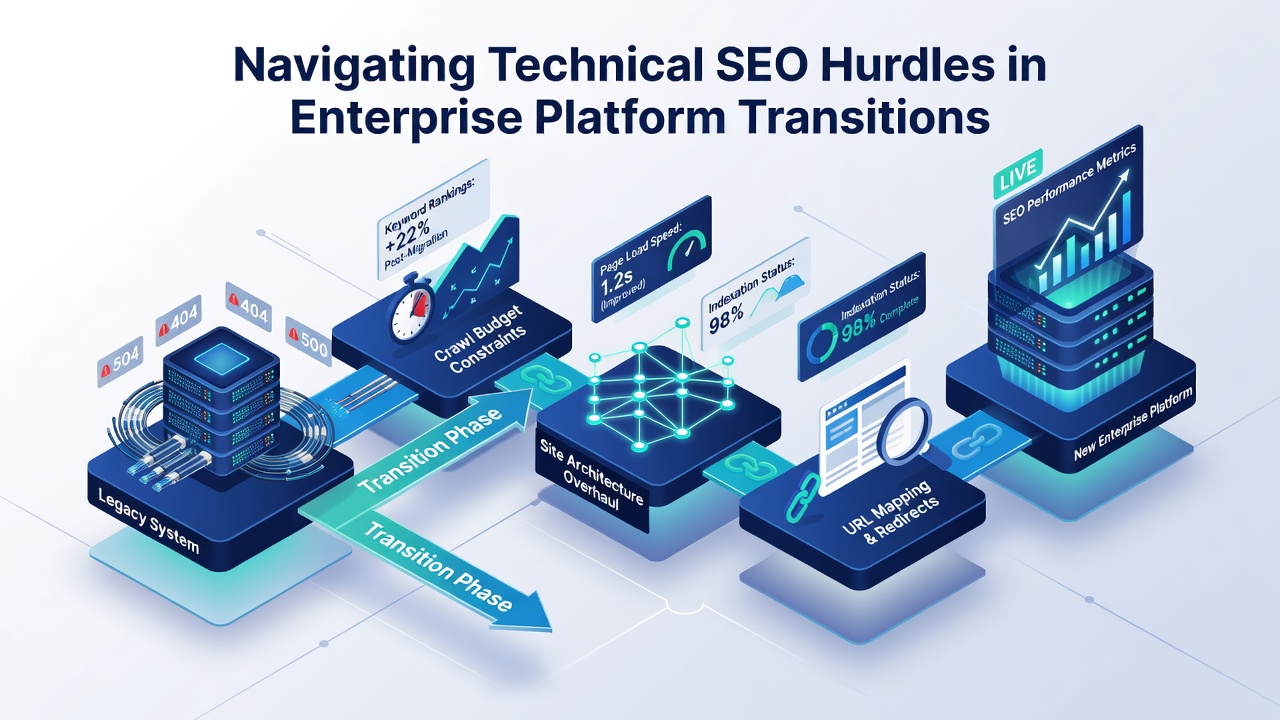
Log file analysis provides concrete insights into how search engine bots interact with transitional sites, and organizations that integrate this data with analytics platforms identify under-crawled sections early enough to adjust server response headers accordingly. International enterprises must additionally account for hreflang implementations that can misfire when platform changes alter directory structures or subdomain setups, resulting in incorrect language targeting that fragments global visibility.
Monitoring and Validation Approaches
Post-launch monitoring relies on tools that track indexing status through search console data feeds, where sudden drops in discovered pages signal unresolved technical barriers. Research indicates that combining server-side rendering with client-side hydration techniques mitigates many rendering issues associated with modern JavaScript frameworks, allowing faster content availability for indexing purposes. Teams frequently establish staging environments that mirror production configurations to test crawl simulations before full deployment, and this practice uncovers potential problems with pagination handling or faceted navigation filters that could otherwise waste resources.
Security protocol updates during transitions, such as shifts to stricter HTTPS enforcement, sometimes interfere with mixed content warnings if embedded resources remain on insecure paths, and figures from web performance databases show these warnings correlate with ranking volatility in competitive sectors. Integration with external services like content delivery networks requires careful header configuration to avoid cache-related indexing delays, while database migration processes can inadvertently alter meta tag outputs if templating logic is not synchronized across environments.
Conclusion
Successful navigation of these hurdles depends on systematic audits that cover every technical layer from server responses to on-page elements, and enterprises that maintain detailed documentation of pre-migration baselines achieve clearer comparisons during recovery phases. Ongoing collaboration between development and SEO teams ensures that platform features align with search engine requirements without introducing unintended constraints on discoverability. As platforms continue evolving, the emphasis on proactive technical validation grows stronger, supported by data that consistently links meticulous preparation to sustained search performance through transitions.